




What Is a Cane Bergere Chair? A Quick Answer Before We Dive In
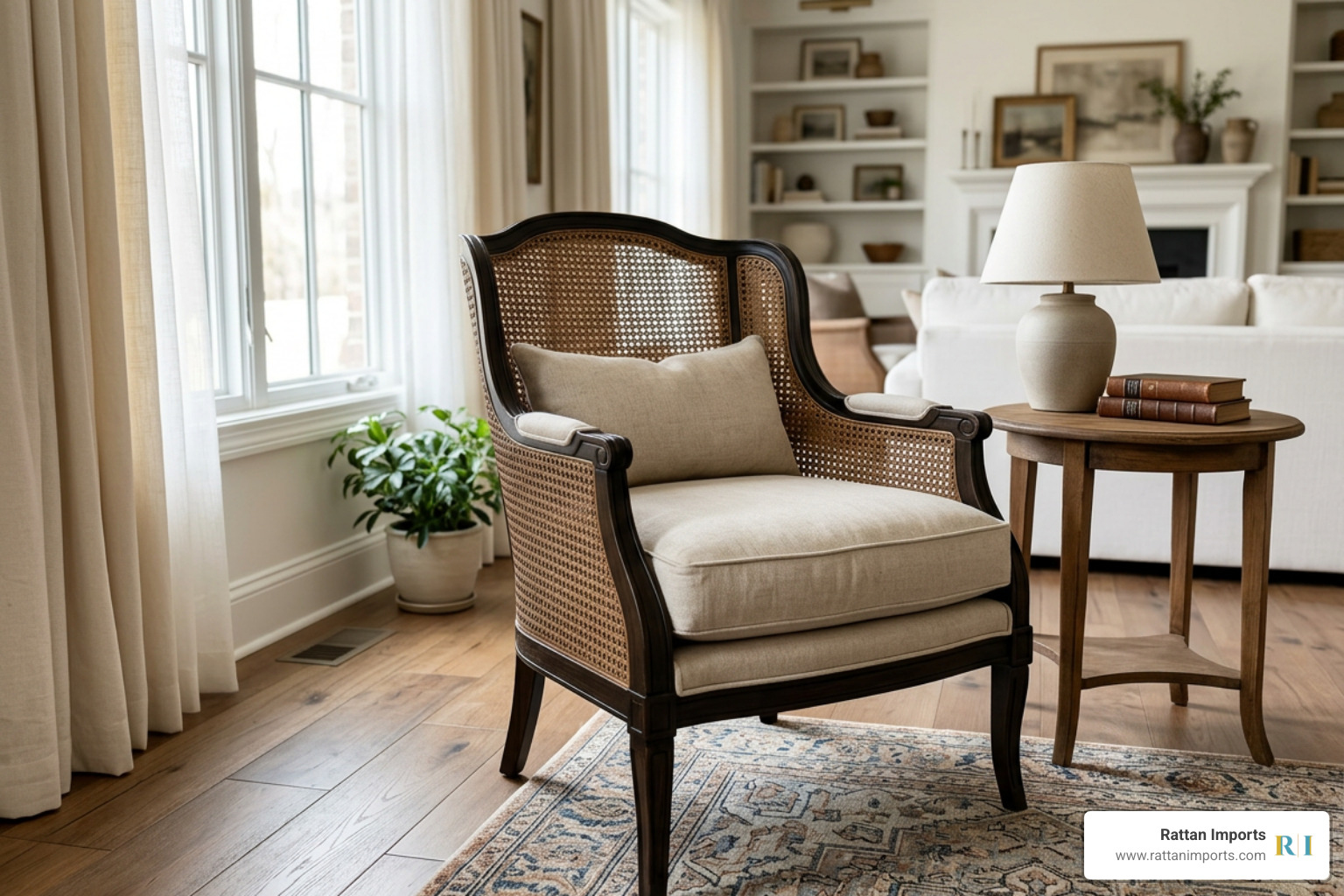
A cane bergere chair is a classic French armchair with a deep, wide seat, an exposed wooden frame, and woven cane panels on the back and sides — instead of heavy upholstery. It sits somewhere between sculpture and furniture: beautiful to look at, comfortable to sit in.
At a glance:
- Origin: France, late 17th century (reign of Louis XIV)
- Defining features: Enclosed upholstered or caned sides, exposed hardwood frame, loose seat cushion
- Key materials: Walnut, mahogany, or oak frame + natural rattan cane panels
- Popular styles: Louis XV, Louis XVI, Regency, Victorian, Edwardian, Danish Modern
- Where to buy: Chairish (1,406+ listings), 1stDibs (60 cane-specific listings), eBay UK (62 antique listings)
- Price range: ~$395 for reproduction pieces up to $15,000+ for rare antique pairs
Whether you're drawn to the ornate curves of a Louis XV original or the clean lines of a 1960s Danish adaptation, the cane bergere chair has a version for almost every interior style.
Few pieces of furniture have survived — and thrived — across three centuries the way the cane bergere chair has. It was originally designed with a notably deep, wide seat to accommodate the voluminous, heavy skirts worn by 18th-century French nobility. Today, that same generous proportioning makes it one of the most comfortable accent chairs you can place in a living room, bedroom, or reading nook.
What makes it so enduring? It balances opposites beautifully. The woven cane brings lightness and texture. The solid hardwood frame brings structure and warmth. The upholstered cushion brings comfort. Together, they create a chair that feels both refined and relaxed — equally at home in a formal French Provincial salon or a modern coastal living room.
I'm Nino Russo Alesi, founder of Rattan Imports and a lifelong admirer of natural materials in furniture design — including the craftsmanship behind a well-made cane bergere chair. My background in hospitality and e-commerce has given me a front-row seat to what people actually want when they bring this style into their homes, and I'm here to share everything I've learned.
Understanding the Anatomy of a Cane Bergere Chair
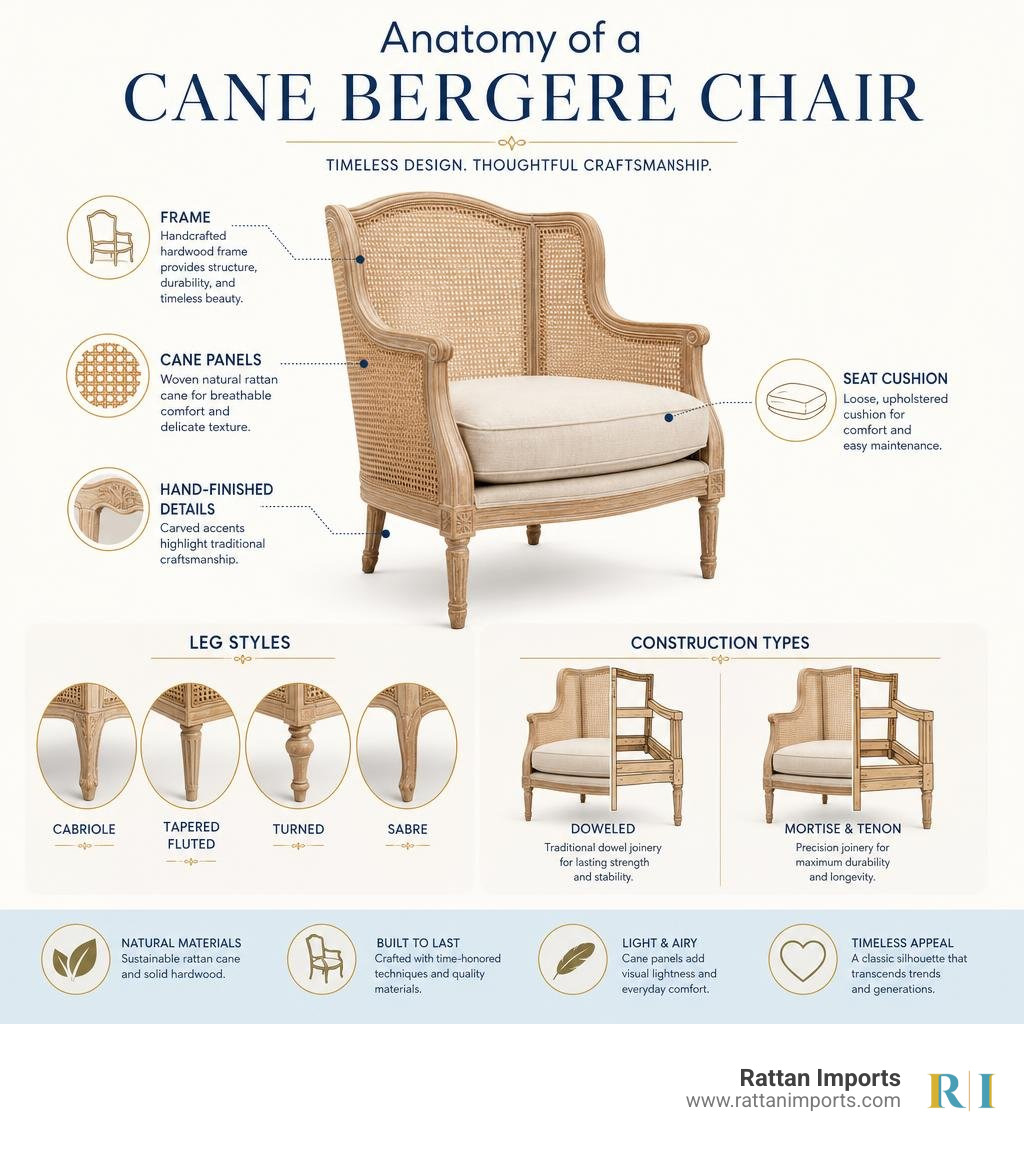
To truly appreciate the cane bergere chair, we must first understand how it is put together. Unlike standard accent armchairs, this French classic relies on a very specific set of structural rules that balance robust woodwork with delicate, airy weaving.
At its core, the chair is defined by its exposed wooden frame. This frame outlines the entire silhouette of the piece, running along the backrest, down the armrests, and down to the legs. The wood is traditionally left in its natural state, stained to a rich finish, or painted in soft, classic French tones (like antique white, sage green, or soft gray) and finished with a matte clear coat to eliminate artificial sheen.
Beneath the loose, plush seat cushion lies a support system. In high-quality vintage and modern models, this consists of sinuous springs (or "S" springs) and heavy-duty nylon webbing attached directly to the frame. Corner block reinforcements are used at the joints of the wooden frame to ensure long-term structural integrity and prevent the chair from wobbling.
The defining feature, however, is the use of natural rattan cane. This cane is woven into panels that are fitted directly into the wooden frame. This design choice was historically practical: it provided lightweight ventilation in warm climates, preventing the heavy, stuffy feel of fully upholstered chairs.
Bergere vs. Fauteuil: How the Cane Bergere Chair Differs
It is easy to confuse different styles of French chairs, but there is one golden rule to remember: it is all about the sides.
Historically, French court etiquette dictated who could sit on what type of seating. The two most popular armchairs to emerge from this era were the bergère and the fauteuil.
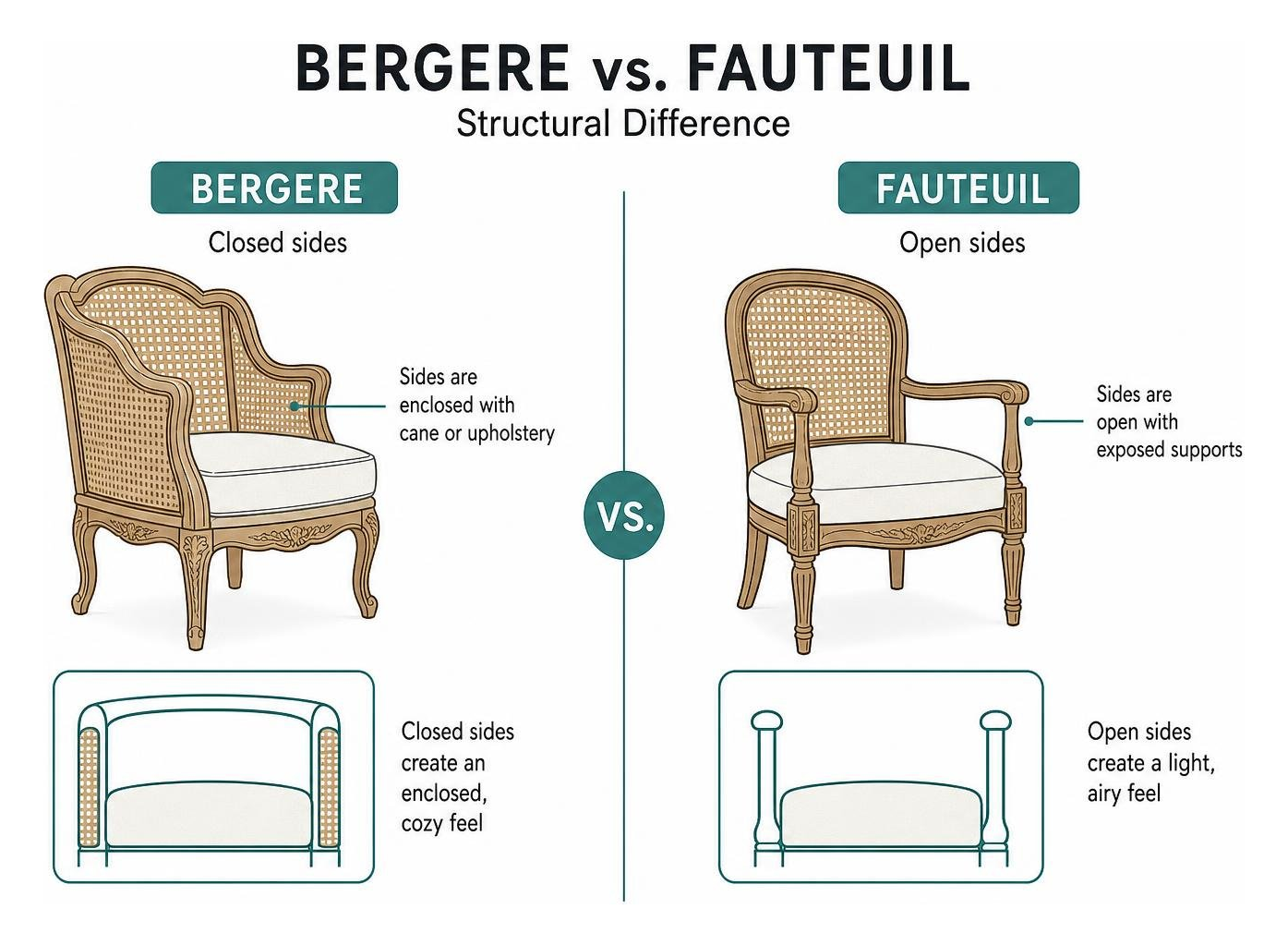
- The Bergère: Features closed, filled-in sides. The space beneath the armrests is entirely enclosed, either with upholstery or, in our case, woven cane panels. This was originally designed to block cold drafts in drafty châteaux.
- The Fauteuil: Features open sides. The space beneath the armrests is left completely open, showing only the wooden support structure.
By enclosing the sides with woven cane, the cane bergere chair offers the cozy, enveloping feel of a traditional bergère while maintaining the visual lightness and airflow of a fauteuil.
Single Cane vs. Double Cane Construction
When sourcing a cane bergere chair, you will often run across the term "double cane" or "double-walled caning." Understanding this distinction is crucial for assessing both the quality and value of a chair.
- Single Cane: The cane webbing is applied to only one side of the wooden frame panel. While beautiful, the backside of the weaving (and the structural groove where the cane is secured) is visible from the other side.
- Double Cane: This is a premium construction technique where cane is woven on both the interior and exterior faces of the chair's arms or backrest. This double-walled design hides the internal structural frame entirely, providing a clean, flawless finish from every single angle. It also adds significant durability and structural tension to the panels.
Historical Evolution and Design Styles
The journey of the cane bergere chair is a global story of design adaptation. It began in the aristocratic courts of France, traveled to the grand libraries of Regency England, adapted to the tropical climates of British colonies, and was eventually stripped down to its minimalist essentials by Scandinavian modernists.
French Court Classics: Louis XV and Louis XVI Styles
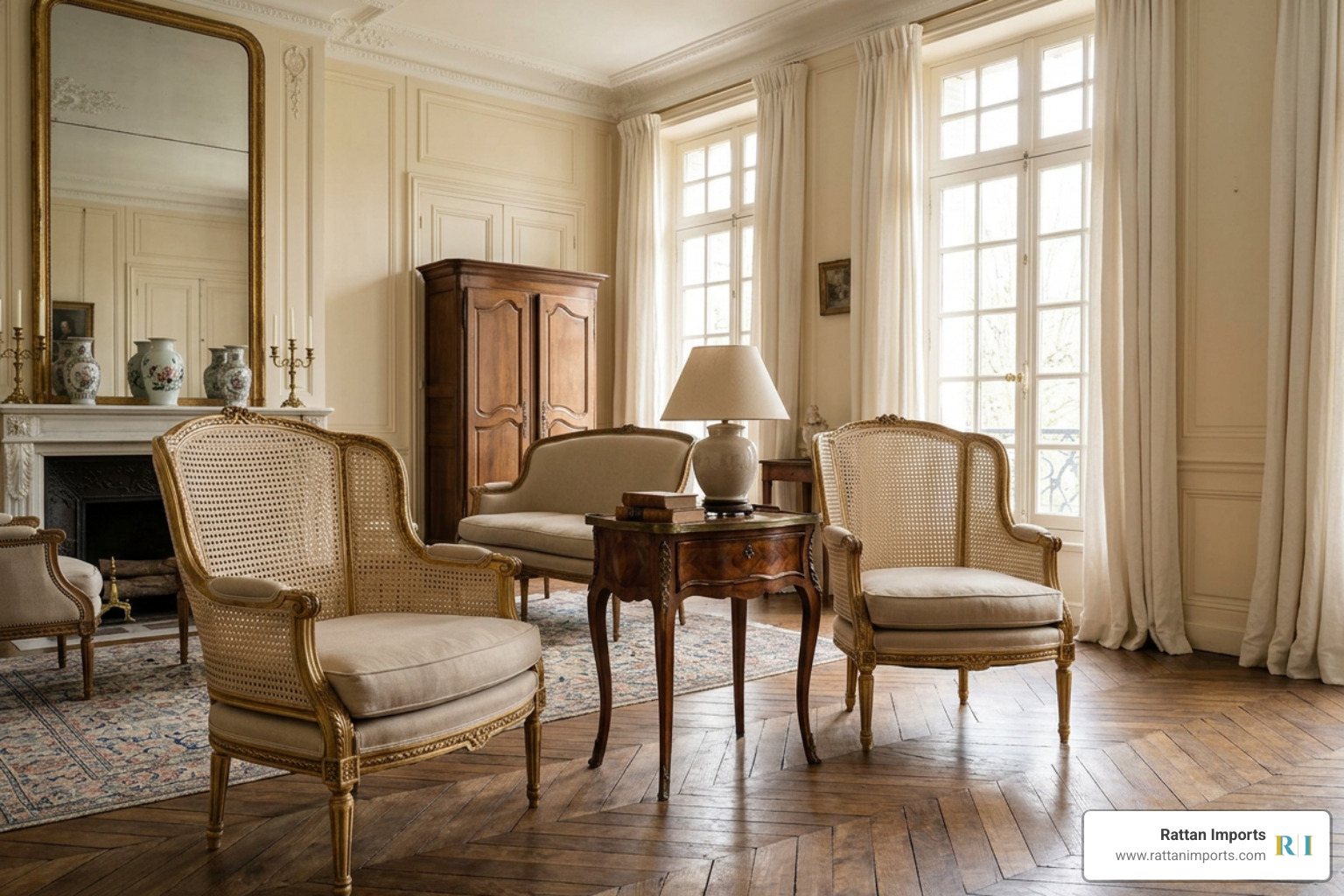
The bergère chair first gained widespread popularity during the reign of Louis XV in the 18th century. The furniture of this era was characterized by soft, organic curves, asymmetry, and a celebration of nature. A Louis XV style chair is easily identified by its elegant cabriole legs, which curve gently outward and end in "escargot" (scrolled) feet. The top of the frame is often adorned with hand-carved foliate crests and floral details.
As the neoclassical movement took hold under Louis XVI, furniture design shifted dramatically toward straight lines, geometric symmetry, and classical Greek and Roman influences. Louis XVI style chairs feature straight, fluted legs that resemble ancient architectural columns, medallion-shaped backrests, and cleaner, more restrained wood carvings.
If you are looking for an elegant reproduction that captures this transitional French look, pieces like the Reproduction Louis XV Style Painted & Cane Bergere - Fireside Antiques showcase how these classic elements — such as trisected cane backs, cabriole legs, and painted wood finishes — are preserved for modern homes.
British Regency and Victorian Adaptations of the Cane Bergere Chair
As the design crossed the English Channel, British cabinetmakers adapted the French form to suit their own tastes. During the Regency and William IV periods (early 19th century), firms like Gillows of Lancaster and London transformed the delicate salon chair into substantial, masculine library chairs.
These chairs were crafted from rich, heavy hardwoods like mahogany and rosewood. They featured deep seats, double-caned sides, and were often paired with luxurious leather cushions. To make them easier to move around library desks, they were frequently fitted with brass castors. Some Victorian models even incorporated industrial wrought-iron swivel and tilt mechanisms.
If you are hunting for authentic English examples, you might come across pieces like the Early 19th Century Bergére cane library chair – TarnLondon, which retains its original historical horsehair stuffing, or a complete Good Quality Late Victorian Bergere Cane Suite as623a1504 - Antiques Atlas, showcasing the late-Victorian love for solid mahogany frames, acanthus leaf carvings, and ball-and-claw feet.
Mid-Century Modern and Global Interpretations
By the mid-20th century, the cane bergere chair underwent another revolution. Designers recognized that the basic anatomy of the chair — an exposed wooden frame with lightweight woven panels — was the perfect canvas for modern minimalism.
In the 1950s and 60s, Danish designers like Bernt Pedersen and Kaare Klint began adapting the traditional French form. They replaced ornate carvings with clean, organic lines and utilized Scandinavian materials like blonde mahogany, oak, and natural cognac leather.
Simultaneously, the mid-century era saw a revival of French provincial styles. Pieces like the 1950s French Bergere Walnut Cane Low Back Lounge Chair | Chairish paired low-slung walnut frames and double-caned sides with bold, modern upholstery choices like snake-print suede and brass leg inserts.
In tropical regions, the design evolved into the Anglo-Indian colonial plantation chair. Crafted from highly durable, moisture-resistant teak wood and woven rattan, these chairs featured extended arms and low-slung seats designed specifically for relaxed outdoor lounging on shaded verandas.
Buying, Restoring, and Styling Vintage Armchairs
Whether you are shopping for a pristine antique, looking to restore a secondhand thrift-store find, or searching for a high-quality new addition, navigating the market requires a bit of know-how.
How to Identify an Authentic Antique
If you are shopping on the secondary market, it is important to know how to separate a true antique from a 20th-century reproduction.
- The Cane Work: Look closely at how the cane is attached. Authentic pre-industrial antiques feature hand-woven cane, where individual strands of rattan are threaded through tiny, hand-drilled holes along the wooden frame. Modern reproductions typically use machine-woven cane sheets that are pressed into a single groove and secured with a spline.
- The Construction: Check the underside of the chair. True antiques will show hand-carved tool marks, irregular joints, and wooden dowels rather than modern metal screws or staples.
- The Stuffing: Gently press the frame beneath the upholstery. Authentic 19th-century pieces used natural horsehair, straw, or coconut fibers for stuffing, which has a much firmer, more fibrous feel than modern polyurethane foam.
- The Wood Patina: Look for natural, uneven wear on the armrests and feet. A century of hands resting on wood creates a soft, rich patina that cannot be easily replicated in a factory.
Restoring and Reupholstering Your Vintage Armchair
One of the reasons the cane bergere chair is so incredibly popular in the DIY "thrift-flipping" community is its high potential for a dramatic makeover. If you find a vintage chair with a sturdy frame but worn-out cushions or damaged paint, you can easily restore it.
- Cleaning the Cane: Before doing any work, gently vacuum the cane panels with a soft brush attachment. Wipe them down with a damp cloth dipped in warm water and a mild soap. Avoid soaking the cane, as excess moisture can cause it to sag.
- Refreshing the Wood: If the wooden frame has a dry, dull finish, apply a high-quality furniture wax or feed-n-wax solution to restore its natural luster. If you decide to paint the frame, use chalk paint for a classic, matte French Provincial look, and apply a sanding sealer first to ensure a smooth, even finish on porous hardwoods like mahogany.
- Updating the Cushions: Replacing old, worn-out cushions is the fastest way to modernize a vintage chair. To keep the look balanced, pair the warm, organic texture of the natural cane with high-quality, breathable fabrics like Belgian linen, rich velvet, or classic cotton damask.
Modern Interior Styling Tips
The beauty of a cane bergere chair is its versatility. It is a design chameleon that can ground a variety of interior styles:
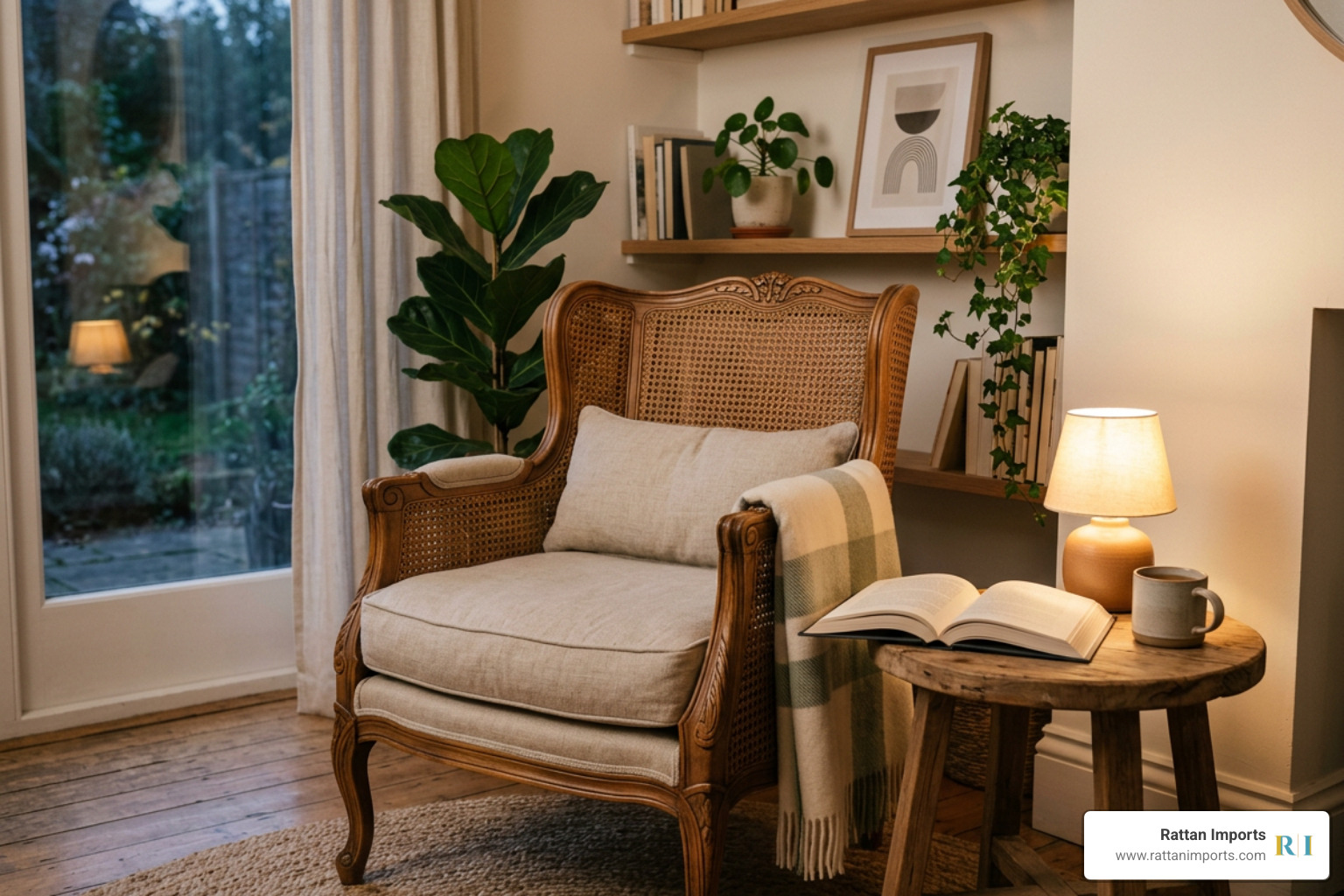
- The Cozy Reading Nook: Place a single, deep-seated cane chair in a quiet corner of your bedroom or study. Pair it with a small wooden side table, a warm brass floor lamp, and a plush kidney pillow for lower back support.
- The Fireside Pair: Position a matching pair of cane bergere chairs opposite your living room fireplace. Because the cane panels are semi-transparent, they allow light to pass through, keeping the hearth area feeling open and airy.
- The Coastal/Transitional Escape: If your style leans toward casual, sun-drenched spaces, pair cane chairs with other natural woven textures like wicker, jute, and linen.
For those looking to bring this relaxed, high-quality aesthetic into their homes without the maintenance hassle of delicate antiques, exploring handcrafted collections like the South Sea Rattan collection is an excellent way to find sturdy, beautifully woven furniture designed for modern living.
| Chair Category | Typical Price Range (USD) | Common Materials | Best Suited For |
|---|---|---|---|
| Project Piece / Thrift Find | $150 – $400 | Mixed hardwoods, worn single cane | DIY restoration, custom paint projects |
| Vintage Reproduction | $400 – $1,200 | Mahogany, birch, machine-woven cane | Daily use, transitional living rooms |
| High-End Antique Pair | $3,000 – $15,000+ | Solid walnut/teak, hand-woven double cane | Formal parlors, collectors, historical homes |
Frequently Asked Questions
What is the difference between single and double caning?
Single caning features a single layer of woven cane, meaning the structural frame and the backside of the weave are visible from one side. Double caning is a premium technique where cane is woven on both the inside and outside of the frame, hiding the interior structure and providing a clean, beautiful finish from all angles while adding extra durability.
How do you clean and maintain natural cane on a bergere chair?
Keep your cane clean by dusting it regularly or using a soft brush vacuum attachment. Wipe it down occasionally with a damp cloth and mild soap. To prevent the natural fibers from drying out, cracking, or splitting, keep the chair away from direct heat sources (like radiators) and direct sunlight, and maintain a moderate humidity level in your home.
Can you paint or stain a vintage caned armchair?
Yes! "Thrift flipping" these chairs is highly popular. You can paint the wooden frame with chalk paint for a classic French Provincial look, or sand and restain it to highlight the wood grain. Just be sure to mask off the cane panels carefully if you want to keep their natural color, or use a light wood stain to refresh the cane's warmth.
Conclusion
From the grand courts of 18th-century France to the airy, texture-rich living rooms of 2026, the cane bergere chair remains an absolute triumph of furniture design. It is a piece that understands that comfort should never come at the expense of elegance, and that structure is always better when balanced with the organic warmth of natural materials.
At Rattan Imports, we share this deep appreciation for natural textures, classic silhouettes, and exceptional craftsmanship. We specialize in premium home decor and furniture sourced directly from the rich artisan traditions of Southeast Asia and assembled right here in the United States.
Whether you are looking to anchor a cozy reading nook or redesign your entire living space, we invite you to Explore premium cane furniture in our curated collections. We are proud to offer a comprehensive price guarantee, free shipping across the U.S. mainland, and a commitment to outstanding customer service. Let us help you bring the timeless warmth of natural cane into your home today!